
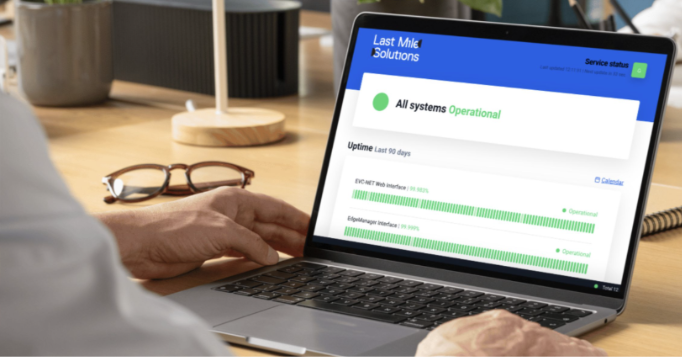
In this article, we explain how you can use Last Mile Solutions’ Status page to see live updates on our platform’s performance and get details on any current issues or planned maintenance.
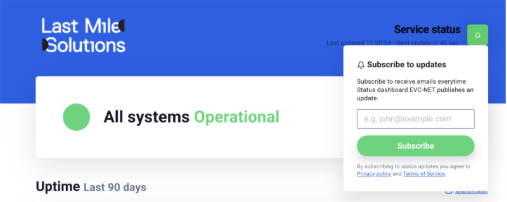
Subscribe to the live updates
We use the Status page to keep our Partners up to date during service disruptions. Subscribe to automatic email updates by clicking the notification button at the top right corner of the page. Remember to also confirm the subscription via the confirmation email!
What’s shown on the Status page?
The Status page shows the uptime and technical status of EVC-net platform, measured through various systems.
- Device Communications – New Architecture: the system maintaining the connections to all Charge Points and devices in the field running on OCPP. This is also known as the Websocket servers. Note: LMS Protocol charge points are connected under the “EVC-NET device communication” section.
- EdgeManager Interface: the system maintaining connections with the EDGE Smart Charging solution devices on the field.
- EVC-net device communication: the system maintaining the connections to charge points and devices in the field running the LMS protocol charge points. This will be phased out in H1 2026.
- EVC-NET Web Interface: the web portal of the platform, where you log into EVC-net platform.
- Platform APIs: the systems receiving and transmitting API messages.
Below these measures, the page shows historical averages. When reading these graphs, please keep in mind:
- The page measures the uptime by connecting to EVC-net from various servers, some also outside of our network. This is done every 30 seconds, making it accurate and robust.
- The colours are indicative of the status and do not correspond to the SLAs.
- Planned maintenance windows, that create planned downtime following our SLA, are excluded from these downtime statistics.
Good to keep in mind
The system uptime reflects the availability of our platform (including servers, APIs, and backend infrastructure) and not the connectivity of individual IoT devices such as charge points. This means a device may be offline even when the status page shows 100% uptime, due to factors like local network issues, power outages, firmware faults, ISP disruptions, Wi-Fi instability, or poor cellular coverage.
Device-specific issues, such as sensor malfunctions, improperly connected cables, or physical damage (e.g., a vehicle hitting the charger), are also independent of overall platform status.
If our services are temporarily offline, charging may still be possible. Charge points can use local caching and whitelists to accept charging sessions and forward the transaction data once connectivity is restored. This approach is particularly feasible in home or office environments, where fraud risks can be more easily managed.