
From the moment that the payment terminal is correctly installed at the charging point, with an active internet connection, activated at Payter and linked to the charging point at EVC-net, drivers can initiate charging sessions by tapping their payment cards to the device.
The high-level process flow:
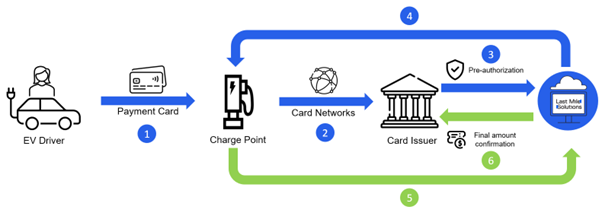
- The driver connects the vehicle to the Charge Point and taps the payment card to the payment terminal present there.
- The Payment Terminal in the Charge Point will send an authorization request to the Card Issuer (financial institution that provided the EV Driver with that payment card). An initial amount of EUR 50,00 (including VAT) will be pre-authorized on the driver’s payment card, which will be the maximum amount that the driver will be able to charge in a single session.
- The Card Issuer authorizes the request and sends the response back to EVC-net.
- EVC-net will remotely start the charge session, and it will start automatically if the driver has already plugged in the car or as soon as the driver connects the car after the payment was made.
- Once the charge session is completed or ended by the driver, the Charge Point will inform EVC-net about the total consumed during the session.
- The driver can stop the charging session at any time by tapping the same payment card used to start the charge session to the Payment Terminal.
- EVC-net will calculate the total cost of the charging session and will inform the Card Issuer of the final transaction amount.
Throughout these steps, a couple of scenarios might happen:
- The pre-authorized amount is higher than the amount consumer during the charging session: In this case, a final authorization message will be sent to the Card Issuer (step 6) to inform about the final transaction amount and release the remaining pre-authorized amount.
- The charging session would require more energy than what was pre-authorized: In this case the charging point will automatically stop the charging session once the charging costs reach the pre-authorized amount. If the driver would like to recharge more, then a new session would need to be initiated and a new payment would need to be made.
- The session failed to start (Step 4): In this case, EVC-net will detect that the charging session was not initiated, and the pre-authorization amount will be automatically released from the driver’s payment card account.
- The driver didn’t connect the car in time (Step 4) – Same as the previous case, the charging session will time out and an automatic release of the pre-authorization amount will be sent to the driver’s payment card issuer.